
Lighting Fixtures Market Size and Trends – 2025 to 2032

2025 Market Size US$272.33 Bn | CAGR (2025–2032) 13.3% | 2032 Projection US$653.09 Bn |
The global lighting fixtures market size is estimated to be US$ 272.33 Bn in 2025 and is expected to reach US$ 653.09 Bn by 2032, exhibiting a compound annual growth rate (CAGR) of 13.3% from 2025 to 2032.
Key Takeaways of the Lighting Fixtures Market
| The indoor lighting segment is estimated to hold the highest market share of 40.7% in 2025. |
| The LED (Light Emitting Diode) segment is projected to dominate the market with a whopping 56.0% share in 2025. |
| Among the end user segment, the residential segment is estimated to lead with a 36.3% share in 2025. |
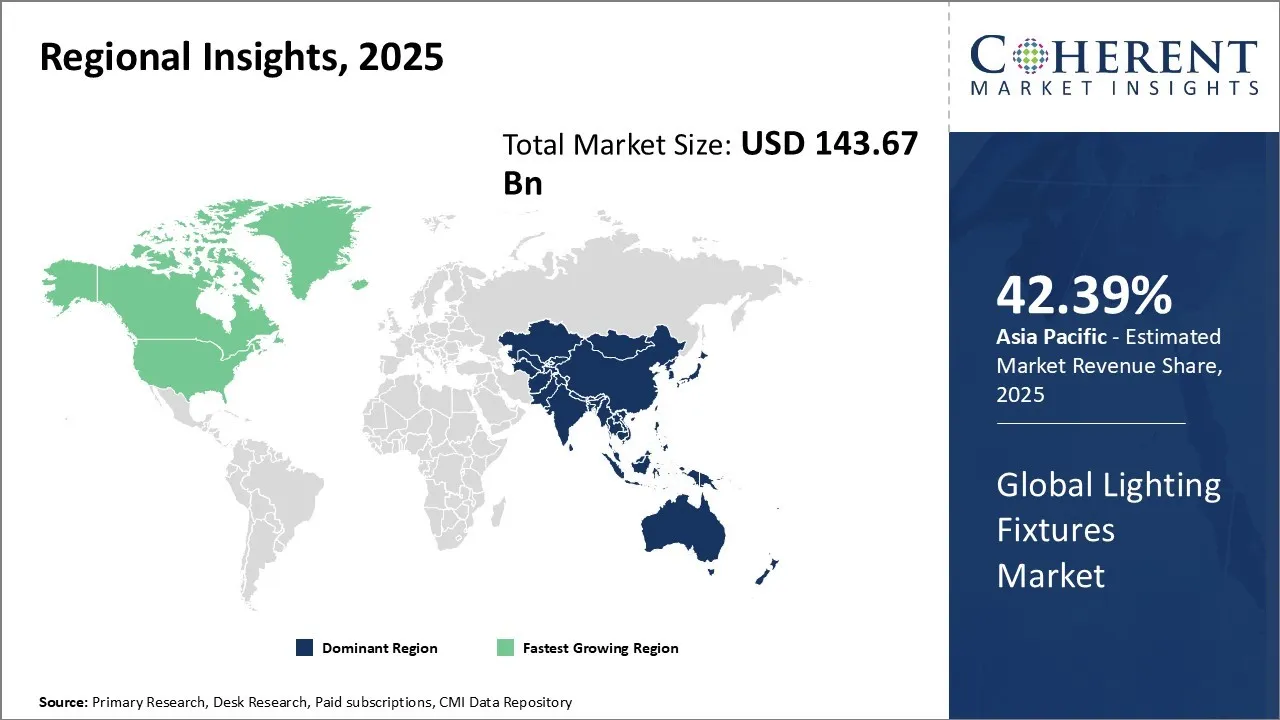
| The Asia Pacific region is estimated to dominate the market with 42.9% in 2025, while North America, holding 27.3% market share in the same year, will witness the fastest growth over the forecast period. |
Market Overview
Rapid urbanization and rising disposable income are fueling the demand for lighting fixtures across both the residential and commercial sectors globally. The market is expected to witness technological advancements such as smart and automated lighting systems. Also, government initiatives promoting the development and adoption of energy-efficient lighting systems will impact the market positively.
Segmental Insights
Product Type Insights — Growing Home Interior Decoration Trends Drive the Indoor Lighting Segment Growth
| Indoor Lighting — 45.6% share (2026) |
In terms of product type, the indoor lighting segment is estimated to hold the highest market share of 45.6% in 2026, owing to the evolving home decoration trends among consumers. With rising disposable incomes and changing lifestyles, consumers are increasingly investing in home décor and interior lighting to enhance the overall aesthetics and ambiance of their living spaces. A wide variety of indoor lighting fixtures are available today catering to different room types and styles, facilitating consumers to experiment with innovative lighting solutions. Technological advancements have led to the emergence of smart and multifunctional indoor lights which can be controlled remotely through apps as per the users' moods and activities. Their energy efficiency and ability to set scene-specific lighting also appeal to environmentally conscious consumers.
Technology Insights — The LED Segment Takes the Lead, Offering Superior Lighting Quality
| LED (Light Emitting Diode) — 55.97% share (2026) |
In terms of technology, the LED (Light Emitting Diode) segment is estimated to dominate the lighting fixtures market, accounting for the largest market share of 55.97% in 2026. This can be attributed to the numerous advantages offered by LED technology such as energy efficiency, long lifespan, and superior lighting quality. As consumers and businesses alike seek to reduce energy consumption and carbon footprints, LED lighting has become the preferred choice for both residential and commercial applications. The increasing adoption of energy-efficient lighting solutions, along with falling prices of LED bulbs, has further accelerated the market growth. Additionally, the versatility of LED technology, which supports smart lighting systems and customizable lighting features, appeals to consumers looking for convenience, sustainability, and enhanced user experience. With ongoing advancements in LED technology, such as improvements in color quality and the development of smarter, IoT-enabled lighting systems, LEDs are expected to maintain their stronghold in the market.
End User Insights — Growing Work-from-Home Trend Augments Adoption in the Residential Segment
| Residential — 36.28% share (2026) |
In terms of end user, the residential segment is estimated to hold the highest share of 36.28% of the market in 2026 owing to the proliferation of work-from-home arrangements in the wake of the pandemic. With the new hybrid working models and flexibility offered by employers, many individuals have embraced distributed living by shifting to suburban homes and holiday homes. This has necessitated the need for dedicated home office lighting along with specific lighting requirements for conducting video calls and working long hours. Moreover, factors such as nuclearization, smaller living spaces, and evolved lifestyles have compelled residential consumers to judiciously light up different areas of the house using recessed ceiling lights, wall sconces, under-cabinet lights, and outdoor landscape lights. The availability of smart lighting fixtures controlled via smartphones further empowers homeowners to optimize lighting for households' convenience and well-being.
Regional Insights
Asia Pacific Lighting Fixtures Market Trends
| Asia Pacific — 45.6% share (2025) |
The Asia Pacific region is estimated to dominate the lighting fixtures market with a market share of 45.6% in 2025. This can be attributed to factors such as large populations, rapid urbanization, and increasing construction activities and infrastructure development across countries such as China, India, and Southeast Asia. Government initiatives to promote LED adoption have also boosted market opportunities.
North America Lighting Fixtures Market Trends
| North America — 27.25% share (2025) — fastest-growing region |
North America, holding an estimated market share of 27.25% in 2025, is expected to exhibit the fastest growth over the forecast period, driven by the strong presence of leading manufacturers, robust economic growth, and rising demand for energy-efficient lighting solutions from both commercial and residential sectors. Key players like Acuity Brands, GE Lighting, and Hubbell Lighting have spearheaded product innovation and new technology adoption in the region.
Lighting Fixtures Market Outlook for Key Countries
🇺🇸 U.S. Lighting Fixtures Market Trends Defined by a strong preference for innovative, energy-efficient lighting, particularly smart lighting. Growing smart-home interest is driving adoption of connected lighting systems offering greater control, customization, and energy savings. High disposable incomes and a focus on home improvements support demand for advanced, sustainable lighting. Companies like CREE lead with LED products focused on efficiency and longevity. | 🇨🇳 China Lighting Fixtures Market Trends Growth is primarily driven by government-led initiatives promoting energy efficiency and environmental sustainability. Policies phase out inefficient technologies like incandescent bulbs in favor of LEDs. The "Made in China 2025" initiative has encouraged innovation within the domestic lighting sector, leading to new, advanced lighting technologies. |
🇮🇳 India Lighting Fixtures Market Trends Fueled by modernization within the residential sector and rising demand for energy-efficient lighting. Government initiatives such as UJALA (Unnat Jyoti by Affordable LEDs for All) have driven widespread LED adoption, significantly cutting household electricity consumption, and creating opportunities for both established players and startups. | 🇯🇵 Japan Lighting Fixtures Market Trends Highly focused on the evolving needs of office spaces, public infrastructure, and smart city projects. Strong demand exists for advanced lighting systems catering to both functional and aesthetic needs. Companies like NVC lead innovation with IoT-based and adaptive lighting control technologies. |
Key Developments and Competitive Intelligence
Key Developments
| Apr 2024 | Govee, a provider of innovative lighting solutions, unveiled its newest additions to the smart interior lighting lineup, Floor Lamp 2 and Floor Lamp Pro, offering adaptable lighting options. |
| Feb 2024 | Fluence, a leading provider of LED lighting solutions, introduced its latest LED top light solutions for produce and decorative cultivators: RAPTR 2 and VYPR 4. |
| Nov 2023 | Halonix Technologies, one of India's fastest-growing electrical companies, launched the 'Wall De-light' fixture, which is six times slimmer than a traditional LED bulb. |
Top Strategies Followed by Global Lighting Fixtures Market Players
Established Players Heavily invest in R&D — companies like Philips, Osram, and GE focus on LED bulbs and smart lighting with longer lifespan and better visual quality. They form strategic alliances with OEMs and tech startups, expand globally via M&A, and ramp up international marketing. | Medium Players Companies such as Cree, Trilux, and Havells India provide affordable yet reliable lighting, sourcing quality components at lower cost. They collaborate with utilities and technology providers to add smart, connected capabilities to their offerings. | Small-Scale Players Boutique brands like V-Tac and Luxon LED specialize in landscape, decorative, or agriculture lighting. Startups leverage AI, IoT, and 3D printing, and tie up with local installers, architects, and contractors to build regional presence. |
Emerging Startups — Lighting Fixtures Industry Ecosystem
Innovative Technologies Companies like LiFi Group are building Li-Fi enabled lamps for high-speed data transmission. Other startups develop robotic arms and computer-vision-powered smart lamps that autonomously adjust lighting in office spaces. | Sustainable Solutions Startups like Starrbot create lamps with vegetable-tanned leather shades or integrate sensors to reduce energy consumption. Some offer LED bulb subscription services to manage lighting waste and cut industry pollution. | Market Contribution Startups such as Illuminations Lighting Design fulfill rising demand for customized accent lighting, horticultural lighting, and LED strip lights for home theaters, partnering with retailers to reach untapped regional markets. |
Market Dynamics
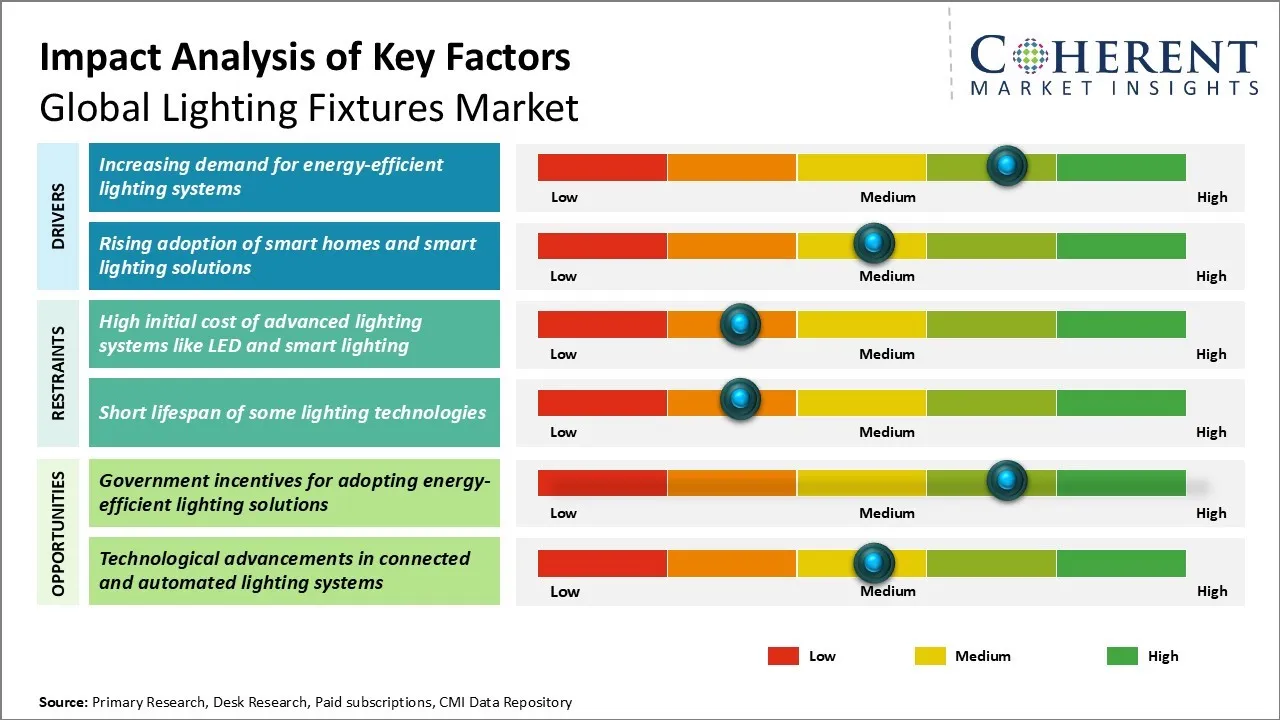
📈 Growth Driver — Increasing Demand for Energy-Efficient Lighting Systems
With growing concerns around climate change and rising electricity bills, energy efficiency has become a priority for both commercial and residential sectors. LED lighting last 25–30 times longer than incandescent bulbs and 5–10 times longer than CFLs, consuming up to 90% less energy for the same output. Government regulations, incentives like ENERGY STAR, and rapidly falling LED prices are driving the global transition to LED, with retrofitting of street and outdoor lighting further boosting the market.
⚠ Challenge — High Initial Cost of Advanced Lighting Systems
LED lights offer a much longer operational lifespan (around 50,000 hours vs. 1,000–2,000 hours for incandescent), but the bulbs remain 2–5 times more expensive than conventional lighting. Smart lighting options that enable wireless control and automation carry a further premium. This high upfront capital requirement deters wider adoption, meaning manufacturers need to reduce bill-of-materials costs to make efficient options more accessible.
💡 Opportunity — Government Incentives for Energy-Efficient Lighting
Many nations offer rebate programs, tax credits, and subsidies encouraging commercial, industrial, and residential consumers to switch to LED and next-generation lighting. Several U.S. states offer US$50–US$100 incentives for replacing incandescent or CFL bulbs with qualified LEDs, while India's EESL program retrofits municipal street lighting with smart, connected LEDs. Such initiatives shorten payback periods and are expected to further stimulate market demand.
Analyst Opinion
The lighting fixtures market is projected to grow significantly over the forecast years, driven by growing popularity and adoption of smart lighting solutions and government support for energy-efficient lighting. Further technological advancement is likely to add more and improved features, boosting popularity.
A major hindrance to market growth could be the high upfront cost of LED or smart lighting systems, which may prevent lower- and middle-income buyers from purchasing them.
Asia Pacific is expected to continue dominating the market as China leads the manufacturing industry, aided by increasing urbanization in the region. North America is expected to show the fastest growth, driven by technological advancements and government focus on energy-efficient lighting.
Market Segmentation
By Product Type Indoor Lighting | By Technology LED | By End User Residential | By Distribution Channel Direct Sales |
Regional Coverage
North America: U.S., Canada | Latin America: Brazil, Argentina, Mexico, Rest of Latin America | Europe: Germany, U.K., Spain, France, Italy, Russia, Rest of Europe | Asia Pacific: China, India, Japan, Australia, South Korea, ASEAN, Rest of Asia Pacific | Middle East: GCC Countries, Israel, Rest of Middle East | Africa: South Africa, North Africa, Central Africa
Lighting Fixtures Market Report Coverage
| Report Coverage | Details |
|---|---|
| Base Year | 2024 |
| Market Size in 2025 | USD 272.33 Bn |
| Historical Data for | 2020 to 2024 |
| Forecast Period | 2025 to 2032 |
| Forecast Period CAGR | 13.3% |
| 2032 Value Projection | USD 653.09 Bn |
| Geographies Covered | North America: U.S., Canada Latin America: Brazil, Argentina, Mexico, Rest of Latin America Europe: Germany, U.K., Spain, France, Italy, Russia, Rest of Europe Asia Pacific: China, India, Japan, Australia, South Korea, ASEAN, Rest of Asia Pacific Middle East: GCC Countries, Israel, Rest of Middle East Africa: South Africa, North Africa, Central Africa |
| Segments Covered | By Product Type: Indoor Lighting, Outdoor Lighting, Smart Lighting, Emergency & Exit Lighting, Architectural Lighting By Technology: LED, CFL, Incandescent, Halogen, Fluorescent By End User: Residential, Commercial, Industrial, Outdoor/Street, Others By Distribution Channel: Direct Sales, Online Sales, Retail Sales |
| Companies Covered | Philips Lighting (Signify), Osram Licht AG, General Electric (GE) Lighting, Acuity Brands Inc., Eaton Corporation, Cree Inc., Zumtobel Group, Panasonic Corporation, Havells India Limited, Schreder Lighting, Targetti Sankey, Fagerhult Group, Lutron Electronics, Legrand, Trilux |
| Growth Drivers | Increasing demand for energy-efficient lighting systems; rising adoption of smart homes and smart lighting solutions |
| Restraints & Challenges | High initial cost of advanced lighting systems like LED and smart lighting; short lifespan of some lighting technologies |
Source: coherentmarketinsights.com — Lighting Fixture Market
FAQs: Lighting Fixture Market
How is smart technology influencing the global lighting fixture market? Smart technology integration in lighting fixtures allows for remote control, energy efficiency, and customization. Businesses can capitalize on the growing demand for smart lighting solutions, offering enhanced user experiences and energy-saving options. |
How do changing consumer preferences impact product design and innovation in this market? Evolving consumer preferences towards aesthetics, functionality, and energy efficiency are driving innovation. Businesses need to focus on designing aesthetically pleasing fixtures with smart features while ensuring energy efficiency to stay competitive. |
How will the lighting fixture industry contribute toward urban infrastructural development? Lighting fixture businesses can contribute to smart cities by integrating IoT technology for intelligent lighting solutions. Challenges include interoperability issues and the need for robust cybersecurity measures. |
What is the role of the sustainability drive in shaping the future of the industry? Sustainability is a key driver, prompting businesses to adopt energy-efficient materials and design practices — incorporating eco-friendly materials, promoting recyclability, and emphasizing energy-efficient lighting solutions. |
Is the rise of e-commerce creating an over-competitive environment for traditional manufacturers? Traditional manufacturers can leverage e-commerce by establishing online platforms, partnering with e-commerce giants, and optimizing supply chains. Embracing digital marketing and direct-to-consumer sales will help them stay competitive. |
How big is the lighting fixture market, and what is its CAGR? The market is estimated at USD 272.33 Bn in 2025 and is expected to reach USD 653.09 Bn by 2032, at a CAGR of 13.3% from 2025 to 2032. |
Which product type and region lead the market? The indoor lighting segment is estimated to dominate market revenue share in 2026. Asia Pacific is expected to lead the global lighting fixtures market in 2026. |
Major players operating in the global lighting fixtures market include Philips Lighting (Signify), Osram Licht AG, General Electric (GE) Lighting, Acuity Brands, Eaton Corporation, Cree Inc., Zumtobel Group, Panasonic Corporation, Havells India Limited, Schreder Lighting, Targetti Sankey, Fagerhult Group, Lutron Electronics, Legrand, and Trilux.
Related Posts

The Global Blueprint: A Strategic Guide for Chinese B2B Manufacturers to Master International Buyer Due Diligence
Executive Summary The landscape of international trade has evolved significantly. For Chinese factories, the path…
How a China Lighting Fixture Manufacturer Can Overcome Tariff Challenges and Global Manufacturing Uncertainty
In today’s complex global market, sourcing high-quality lighting fixtures is more challenging than ever. International…
Smile Lighting Co., Ltd.
so, i think we can focuse some items below:
Enhance Customization & Flexibility:
OEM/ODM Excellence: Continue to develop our capabilities in offering customized solutions that cater to diverse customer needs. Emphasize flexibility in design, material selection, and technological features.
Tailored Innovations: Consider launching personalized lighting solutions that integrate customer-specific design elements and smart features.
Focus on Technological Innovation:
Smart Lighting Integration: Invest in IoT-enabled and energy-efficient smart lighting systems. As demand grows for connected and sustainable products, further enhancing our smart lighting portfolio will meet market trends.
R&D Investment: Boost our research and development efforts to stay ahead of technological advancements and emerging trends in lighting fixtures.
Sustainability & Energy Efficiency:
Eco-Friendly Materials & Processes: Strengthen our commitment to sustainability by incorporating recycled or eco-friendly materials and energy-efficient production methods.
Certifications & Standards: Secure relevant certifications (like ENERGY STAR, RoHS, etc.) to reassure customers about the environmental benefits and compliance of your products.
Quality & Reliability:
Rigorous Quality Control: Enhance quality control processes to ensure consistent, high-performance products that exceed customer expectations.
After-Sales Support: Provide exceptional technical support and robust after-sales services to build long-term relationships and trust.
Market & Customer Engagement:
Global Expansion: Leverage market trends showing rising demand in various regions by expanding our global outreach and marketing efforts.
Feedback-Driven Improvements: Regularly gather customer feedback to fine-tune product features, address concerns promptly, and innovate according to market needs.
Smile Lighting Co., Ltd.
Threats:
Intense Global Competition: The lighting industry is highly competitive, with many players advancing in technology and design.
Economic Fluctuations: Global economic uncertainties can affect consumer spending and investment in infrastructure.
Regulatory Changes: Evolving standards and regulations on energy efficiency and environmental impact could require rapid adjustments in production processes.
Supply Chain Disruptions: Dependence on raw materials and manufacturing processes could be vulnerable to global supply chain issues.
Smile Lighting Co., Ltd.
Opportunities:
Growing Demand for Smart & Sustainable Lighting: Capitalize on the global trend towards energy efficiency and IoT integration.
Expansion into New Markets: Opportunities for global expansion, particularly in regions with increasing infrastructure development.
Collaborative Partnerships: Form alliances with architects, designers, and tech companies to integrate your lighting solutions into broader smart home or commercial projects.
Rising Consumer Interest in Customization: Increased demand for personalized lighting solutions can drive growth through tailored product offerings.
Smile Lighting Co., Ltd.
Weaknesses:
Brand Recognition: While strong in industry circles, there might be opportunities to boost brand visibility in new or emerging markets, so we redesigned our logo some days before, more details, please visit: https://www.smilelighting.com/2025/03/10/exciting-announcement-introducing-our-new-smile-lighting-logo/
Market Concentration: A potential risk if too heavily reliant on certain market segments or regions, we relied on our trade company partners so heavily before, 🙁
Adaptability to Rapid Technological Changes: Continuous investment in R&D is necessary to keep up with fast-evolving smart lighting technologies.
Smile Lighting Co., Ltd.
SWOT Analysis for SmileLighting: Strengths:
Extensive Industry Experience: Over 20 years of expertise, which establishes credibility and deep market knowledge.
Advanced Manufacturing Capabilities: State-of-the-art facilities, rigorous quality control, and skilled craftsmanship.
Customization Expertise: Strong OEM/ODM capabilities that allow for tailored, innovative lighting solutions.
Product Diversity: A wide range of products catering to both traditional and modern interior design styles.
Smile Lighting Co., Ltd.
actually, Mr. Colin Jiang entered in lighting fixture industry 30+ years before, he started his career as an apprentice in another lighting fixture manufacturer.
Smile Lighting Co., Ltd.
This report serves as a valuable resource for industry professionals seeking to understand the future direction of the lighting fixtures market.
1. Comprehensive Market Analysis: it provides an in-depth look into the lighting fixtures market, offering forecasts and detailed analysis for the period 2025 to 2032.
2. Growth Drivers & Trends: It highlights the main factors driving market growth—including technological innovations, energy efficiency improvements, and rising demand in both residential and commercial segments.
3. Competitive Landscape: The content examines key players, market share dynamics, and competitive strategies within the industry, giving readers a clear view of the competitive environment.
4. Data-Driven Insights: With charts, statistics, and trend projections, the article supports its analysis with data that helps predict future market performance and emerging opportunities. But unfortunately I cannot afford it, also i think our market is not so big.
5. Sustainability Focus: The report also touches on how sustainability initiatives and eco-friendly products are shaping consumer preferences and influencing market trends.